Technical Notes
Source and Reference
This module serves as an enhanced input/output interface for the widely used WSPRO program developed by the USGS. WSPRO (Water Surface PROfile) and its underlying algorithms are implemented in many modeling software packages. The ChannelRatingWSPRO module utilizes the 1998 edition of WSPRO. For further technical details, users are encouraged to consult the official user manual available on the USGS website.
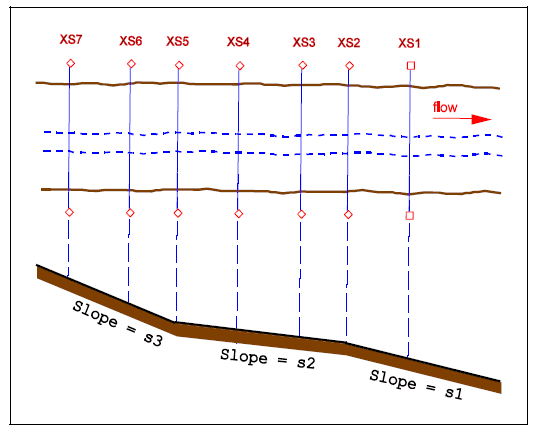
Sketch of multiple cross-sections considered along a reach, ,shown in plan and cross-section.
Single cross-section Solution Steps and Considerations
The single cross-section method of rating curve estimation is a simplistic method comonly used in practice, mostly because of its simplicity for manual calculation. However, the results may not be accurate. Please see our case studies for more information.
Manning's flow equation is the basis for calaulations of stage-discharge relationship, in both single and multiple section methods of solution.
The solution process for this method, implemented in ChannelRate module, can be summarized as follows:
-
The height of cross-section is subdivided in to equal heights of flow, yi
-
For each level, the geometric properties of Area, and perimeter are calculated.
-
If multiple segments (varied N roughness values) are used, an arthimatic mean is used for calcualtion as follows: Navg= (N1+N2+...)/Number of segments
-
The slope value provided in calculation paramters is considered as the average river bed slope.
-
The discharge capcity is then calculated using all paratmers, for each water level determined in step 1.
-
The final results for specific discharges by the user, are generated by using interpolation methods, and recreating the solution.
Note: Discharge values for the final rating curve may slightly shift, due to the above interpolation process.
-
Finally, for each level of flow the critical flow velocity and correponding flow rate is determined from
and
where is the flow depth. and is the flow area at .
The final solution is presented as shown below.

Sample rating curve generated by ChannelRate_WSPRO
Multiple Cross-sections Solution steps and considerations
The governing equation for gradually varied flow is used for solving water surface profile. Conventionally, these are commonly solved using such methods as standard-step method. ChannelRate integrates the WSPRO algorithm for numerically modelling the solution process, and presents the results.
The user defines all the cross-sections, their roghness values, and their relative locations in detail following the modelling steps outlined earlier. For each discharge value specified by the used, the solution process is summarized below:
- The boundary slope condition is determined based on the users preference to the Boundary Condition variable. The user can choose to use the same as provided slope, or force a critical flow condition. In the latter case, the flow surface at critical condition is internally calculated and used as the boundary value.

Set boundary conditions for friction slope consideration
- Solution starts at the downstream most cross-section. For this section, yi is ddetermined for each discharge value, by using So from above boundary condition.
- For the next cross-secion, the above determined yi is used along with the geometric (cross-section and segment slope) and hydraulic parameters(N) values are used, to determine the new yi.
- The solution repeats through each intermediate seciton, and stops after solving yi for the base cross-section.
If multiple N values are encountered at any given section, then the weighted average value is derived based on the portions of sub-areas wetted by yi.

In the above equation,
- nc is the composite or equivalent coefient of roughness
- P is the wetter perimeter of entire channel
- Pi is the wetted perimeter of sub-area
- ni is coeficient of roughness of individual subareas.

Example of considering N variations for weighted N values calcualtion
The resulting rating curve, presented on the main interface as graph, and tabular values represent that of the base cross-section.
Water surface profile computaition result can also be visualized for all cross-secitons and discharge values.
Recommended Usage
The method of computation used for water surface level computation, as is widely established in practice, uses a number of cross-sections to establish a good estimate of flow level. Usually up to seven cross-section data are used. Using more cross-section data may not improve the accuracy of the results any further. Using less cross-section data however is known to limit the accuracy of the result. This is an important factor to note, as currently only one cross-section can be used in the module.
Note on Elevation Limits for Profile Computation: When preparing cross-seciton data (for use with Multiple Sections method), the user should attempt to code any open-channel cross-section to include at least one ground point higher than any computed water-surface elevation that can reasonably be expected.
Flow surface is estimated by starting at a cross-section, and estimating the normal flow depth there. This is achieved by using the equation:
Then the water surface profile at the next cross-section is estimated by using equations of the direct-step method developed to account for friction slope and flow-energy gradients.
As the solution progresses to the farthest upstream cross-section, the accuracy of calculated water surface level to represent actual flow levels increases. In the sketch shown above, the computation the beginning cross-section would be XS1 and the ending cross-section would be XS7.
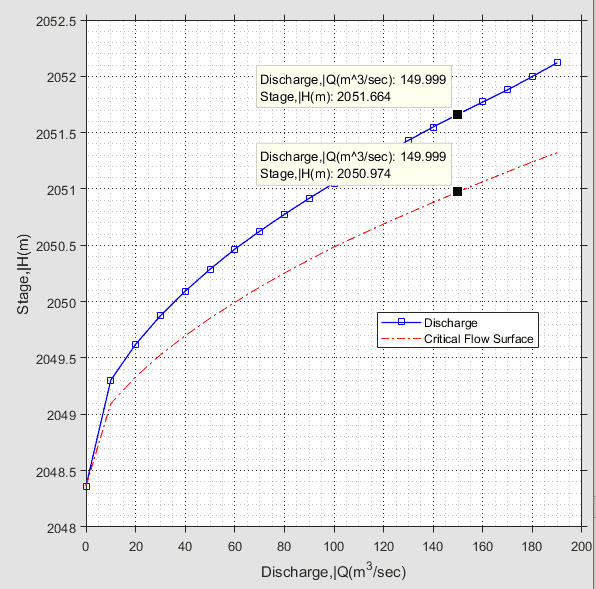
Sample rating curve generated, for normal flow and critical flow conditions.
iCAD presents solution for stage-discharge relationship as shown below, including critical flow surface levels for the range of discharge values supplied. In the figure for example, WSP for Q=150m^3/sec is @2051.664. For the same discharge the critical flow WSP is @2050.974, i.e., , indicating subcritical flow.
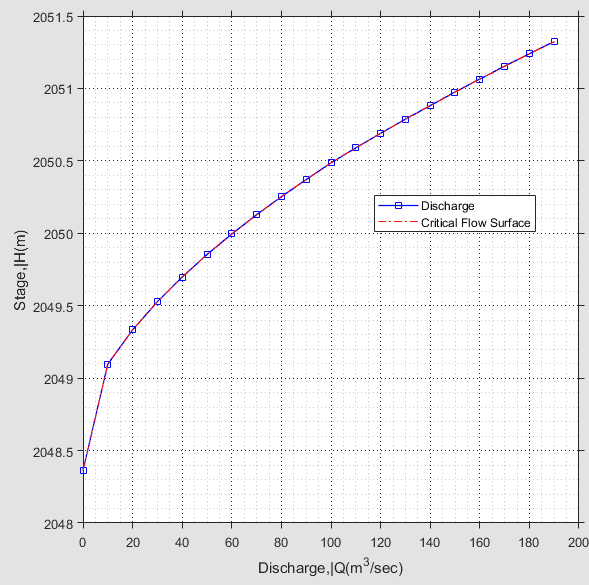
Sample rating curve generated by ChannelRate_WSPRO
As the canal bed slope is increased, the normal flow depth approaches the critical flow depth.
After a certain slope, or more precisely the critical slope, the normal flow depth should be lower than the critical flow depth. However, this is not properly represented. As the next result snapshot shows, the two lines simply overlap wrongly showing for any discharge the critical flow surface and the normal flow surface are the same.
This happens because, critical flow computation is carried out downstream assuming critical flow at the starting cross-section.
Avoiding Pitfalls
The following screenshot shows a water surface profile (WSP) plot created using multiple sections method. The WSP for Q=400 is odd, and obviously not a good solution.
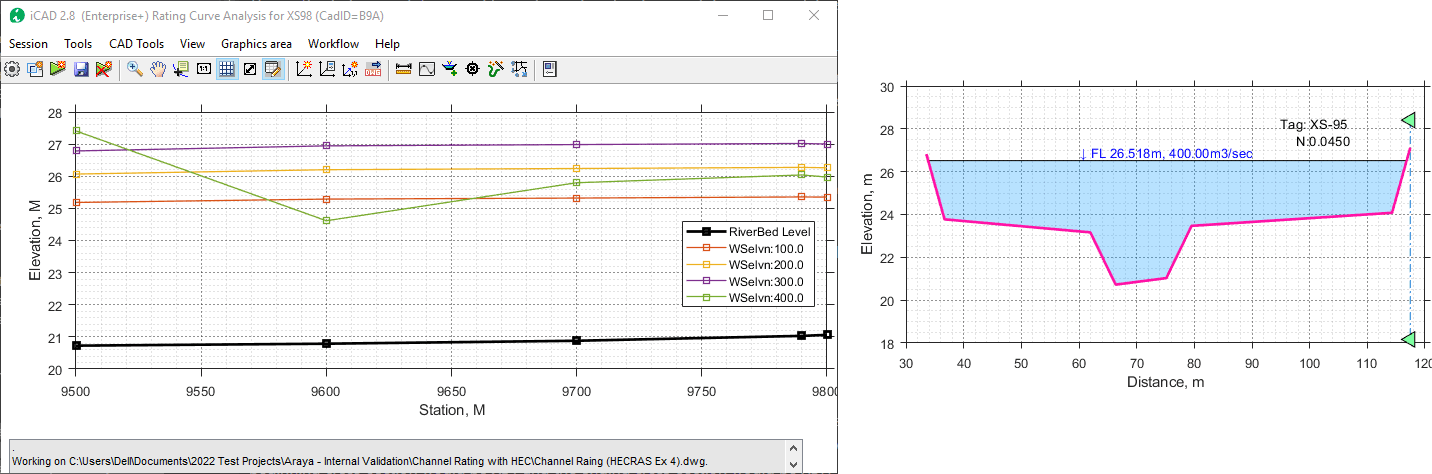
A WSP for a higher discharge is ploted below that of lower discharges. An example of problematic cross-section data.
If this happens, check the cross-section data provided. They are not sufficiently higher than the maximum antiticpated WSP level. As can be seen on the right, for the given discharge, the water level is almost equal to the provided cross-section data. In such cases, the computation results are not reliable (as noted early in this Technical Note section.)
To avoid such pitfalls, we recommend setting boundary conditions to Critical flow conditions. With this setting, the profiles are computed with out errors as shown below.

Solving the issue by adjusting solution parameters.